
Pattern 01 / Move
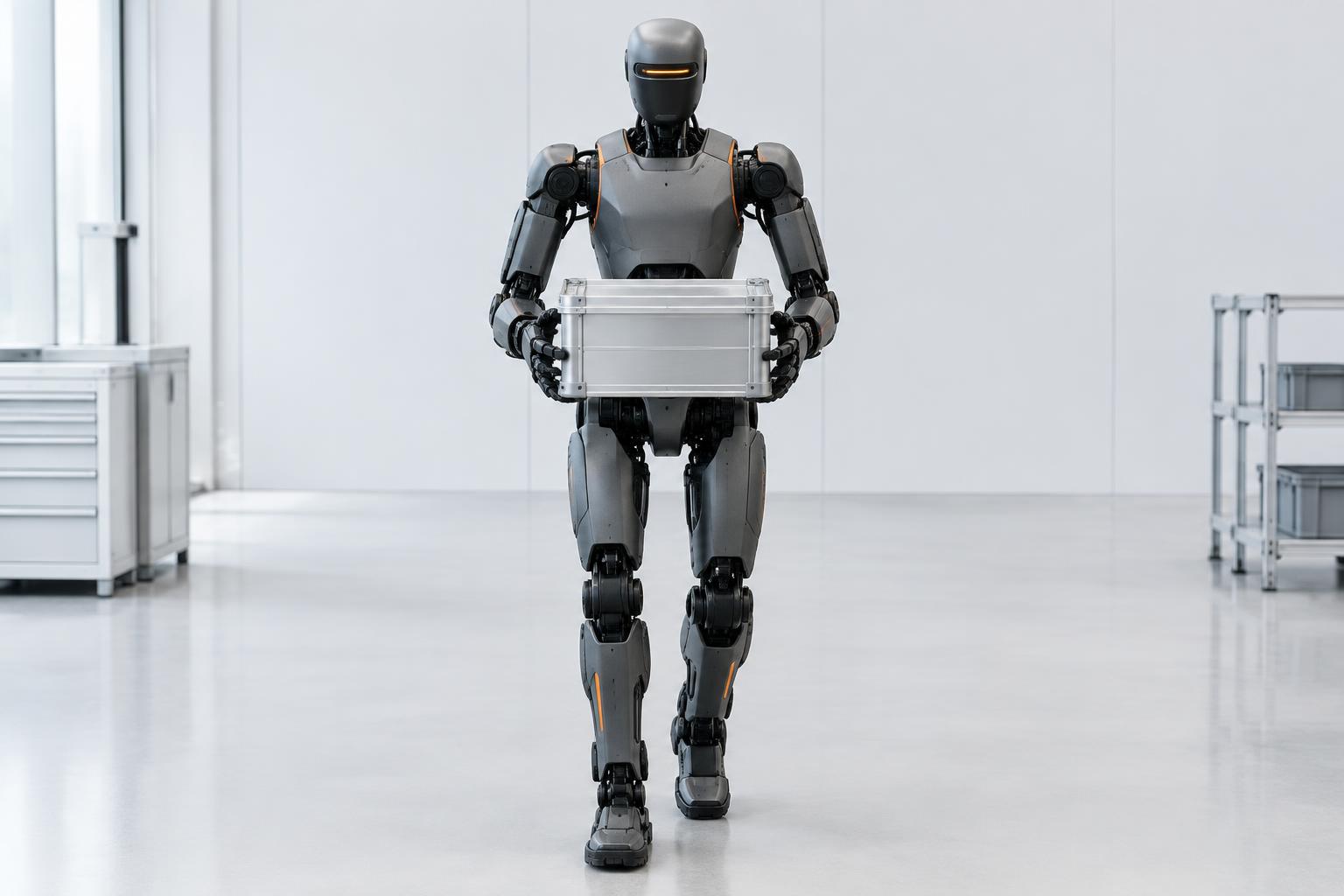
Internal logistics
Consider predictable transfers between defined points. Review routes, doors, lift access and pedestrian crossings first.
A field guide to where mobile and humanoid robots may help in shared workplaces, and the questions to answer before a pilot begins.
Explore the use cases
Robotics earns a place in a workflow when it handles a clear, repeated job safely and leaves people in control of exceptions.
Consider predictable transfers between defined points. Review routes, doors, lift access and pedestrian crossings first.

Repeated setup and reset work may be assisted where objects and locations are consistent and easy to inspect.
Wayfinding and status updates can be explored when a person can easily step in and information stays current.
Use this as a starting conversation with operators, facilities, IT and safety teams. Every site needs its own assessment.
Good pilot signal
Questions to resolve
Stable routes and repeatable loads
What happens at crossings, blocked paths or handoffs?
Known layouts and easy-to-check outcomes
How are exceptions identified and corrected?
Clear requests and a staffed escalation path
Who owns the accuracy of directions and schedules?
Defined, low-variation objects and bounded zones
What are the safe limits, and who confirms them?
Keep the first experiment small, observable and easy to stop while the team learns what the workflow actually needs.
Document the job, its frequency and its awkward exceptions.
Mark routes, people, physical constraints and information dependencies.
Set a narrow operating area, clear stop conditions and named owners.
Compare outcomes with a baseline and decide whether to adjust or end.
These concepts are illustrative. No deployment, performance, compliance or safety certification is claimed. A real system requires site-specific risk review, testing and operator training.
This page presents independent design studies and use-case ideas. It does not represent a product catalogue or confirm availability.
Autonomy depends on the task, environment and system. A real deployment needs defined limits, monitoring, escalation and a human response plan.
Choose measures tied to the workflow, such as completion time, interruptions, handoff quality and operator workload. Set a baseline before the pilot.
No inquiry forms or payment tools are provided. The examples and imagery are illustrative.